


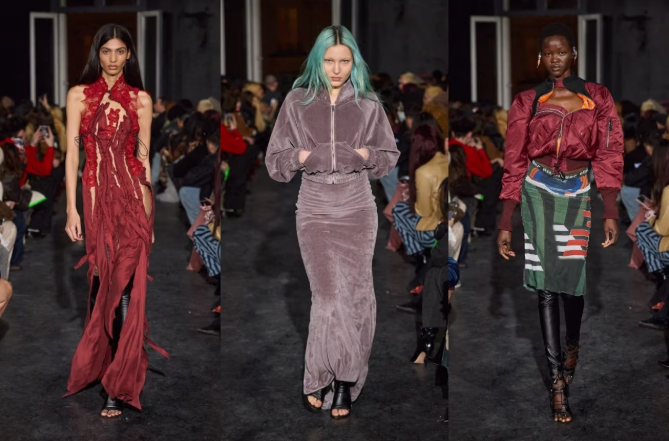
At Paris Fashion Week Fall/Winter 2026, Ottolinger once again proved that fashion shows can be more than presentations — they can be experiences. The German design duo behind the brand delivered a runway event titled “Female Fools” that blurred the lines between performance art, subculture aesthetics and high fashion.
Onlookers witnessed an energetic mix of exaggerated silhouettes, eclectic styling and an innate punk spirit. Instead of a straightforward fashion narrative, Ottolinger offered a sensory journey — one that felt nostalgic, irreverent and fiercely individualistic.
A Show with Attitude
From the moment the models hit the runway, it was clear this wasn’t going to be a typical fashion presentation. Ottolinger’s aesthetic has always favored contradiction: harsh meets tender, deconstruction meets precision tailoring, DIY ethos meets couture sensibility.
For the FW26 show, this duality took center stage in the collection’s styling. Models wore layered pieces that echoed workwear and uniform elements but with an intentional drag — oversized sleeves, asymmetrical zippers, distressed fabrics, experimental proportions.
Rather than smoothing over differences, the collection accentuated them, embracing instead of hiding the rough edges and quirks that give clothes personality.
The Philosophy Behind “Female Fools”
While any description of the collection’s looks only tells part of the story, the title “Female Fools” hints at Ottolinger’s conceptual play: Why should fashion be polished? Why impose rules on expression?
The term speaks to the freedom of being unfiltered, spontaneous or even absurd — positioning fashion as a playground rather than a podium. In a season where other brands leaned into minimalism or hyper‑glossy glam, Ottolinger doubled down on rawness and unpredictability.
This conceptual grounding was reflected not only in the clothes but also in how they moved and interacted on the runway. The pacing wasn’t uniform. There were moments of stillness, bursts of energy, and a sense that the models were not merely displaying outfits, but inhabiting characters.
Layered Looks That Resisted Convention
Ottolinger’s signature exploration of volume and texture was on full display. Some of the most striking looks included:
- Oversized outerwear layered over tailored pieces: Jackets and coats were puffed and slouchy, yet paired with structured shirts or trousers, creating a dialogue between comfort and precision.
- Distressed fabrics with raw edges: Instead of pristine textiles, many garments featured intentional fraying, patchwork and unrefined finishes that gave the collection a lived‑in feel.
- Utility‑inspired details: Workwear buckles, industrial hardware, straps and loops appeared across multiple looks, adding tactile complexity and a nod to functional clothing.
- Unexpected proportions: Sleeves extended dramatically, torsos were cinched with exaggerated belts, and trousers balanced length with volume — all suggesting a sense of controlled chaos.
Taken together, these elements created a collection that felt inventive rather than polished — a rebellion against fashion’s usual insistence on sleek silhouettes and restrained elegance.
Hair and Makeup: A Continuation of the Message
Ottolinger’s vision extended beyond the clothing into hair and makeup. Beauty choices accentuated the themes of individuality and raw expression. Rather than soft, blended makeup, faces embraced strong contrasts — bold flashes of color, unrefined shading and unapologetic texture. Hair was styled in ways that resisted perfection: tousled, sculptural, and decidedly personal.
This beauty direction underscored the idea that fashion is an extension of personality, not a mask to be washed off at the end of the day. The overall effect was that each model appeared less like a mannequin and more like a story unfolding in real time, with beauty serving as another layer of narrative.
A Show That Felt Like Performance
Unlike runway shows that feel tightly choreographed to maintain distance between audience and clothes, the Ottolinger presentation felt alive — as though the garments were characters in motion rather than objects to be examined.
There were moments that broke expectation: spacing that was unintentionally lyrical, pauses that felt like self‑reflection, glances that suggested mood rather than message. It wasn’t just a runway; it was a performance where unpredictability was part of the thrill.
In a fashion environment often dominated by meticulously polished presentations, this felt like a refreshing jolt — a reminder that fashion can be playful, rough around the edges, strange and magnetic all at once.
What This Says About the Current Fashion Moment
Ottolinger’s show pushed against the grain of glossy, hyper‑produced runway events. In contrast to immaculate tailoring and smooth surfaces, the brand treated fashion as something alive and imperfect — full of contradictions and personality.
This is not a rejection of quality or craft; rather, it’s a reimagining of what those things can look like in a creative context that celebrates imperfection as part of human expression. The collection didn’t aspire to be aspirational in the traditional sense. It aspired to be felt, experienced and digested as raw emotion manifested through clothing.
In a cultural moment where authenticity is valued — where individuality and imperfection are increasingly celebrated — Ottolinger’s “Female Fools” felt like a bold statement. It suggested that fashion doesn’t need to be removed from life; it can be life — messy, expressive, unpredictable and unapologetically personal.
A Runway Worth Remembering
By the end of the presentation, the statement was clear: Ottolinger wasn’t just showing clothes. The brand was telling a story — one that defies standard fashion codes and invites the audience to rethink what beauty, structure and expression can be.
“Female Fools” embraced the idea that clothing can be playful, chaotic, expressive, and emotionally layered — not just aesthetically pleasing. It reminded viewers that fashion, at its most powerful, doesn’t just decorate the body; it illuminates the mind.
In an era where runway shows can feel predictable, this collection stood out as an example of fashion as art, narrative and cultural commentary — a reminder that what we wear can be a reflection of how we think, feel and choose to exist.